Sunday, January 13, 2019

A snowboarding adventure in the Arctic Circle

I'm on top of the world, in all senses of the term: we're 500 miles inside the Arctic Circle in Norway's Lyngen Alps and I'm buzzing at having reached the summit of Riššavárri, after a 31/2-hour hike.

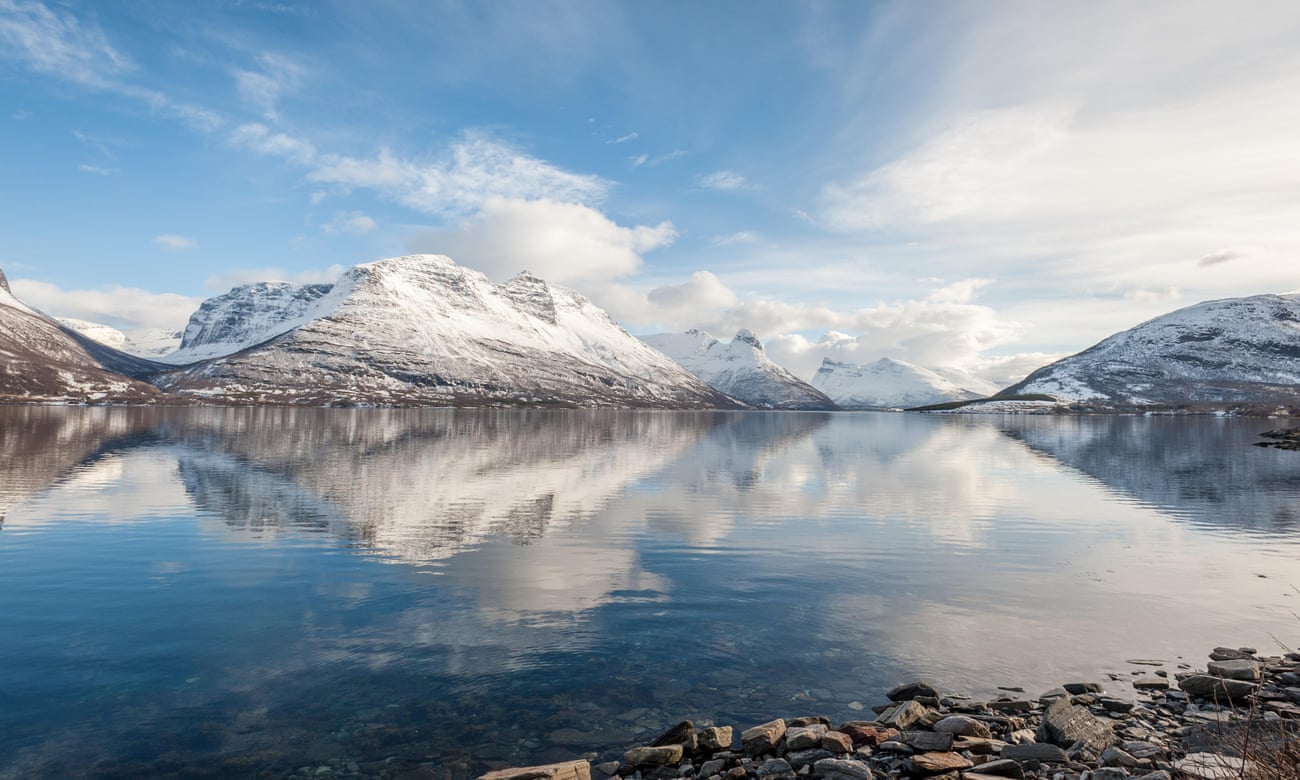
Jagged white peaks rise starkly from snaking, deep blue fjords, the sun is shining, the light's amazing – and there's no one here but me and my guide, Mikal Nerberg. With more than 60 summits over 1,000 metres, the Lyngen Alps have a quasi-mythical status among hardcore skiers. It's a purely touring destination: there are no ski lifts, so any mountain you want to ride down you have to hike up, using “skins” on your skis for grip. With ski fans increasingly wanting a fitness break, rather than just boozy lunches and downhill meanders, touring is a growth area.

The Lyngen Alps is where alpine guides come on holiday once their European season finishes, and where they bring their best and favourite guests. I'm here in early April but the season runs until June, when there's skiing in the midnight sun.

We planned our route the day before, poring over a giant map, with Mikal pointing out the many peaks at our disposal. Riššavárri, at 1,251 metres, seems a good entry-level option. The temperature hasn't fluctuated dramatically lately and it hasn't snowed for a week so the snow pack should be stable, though as this is the high Arctic the weather can suddenly change. “This is more like a mountain expedition than you might expect,” said Mikal.

Instead of getting a resort bus or cable car to our starting point, we take a ferry across the fjord from Lyngseidet to Olderdalen. Our hike begins at sea level, rising up through a forest of elder and silver birch, the trees bowed under the weight of the snow. Mikal is on touring skis, while I'm on a splitboard - a snowboard that splits in two so it can be used like touring skis. The way isn't too steep, but Mikal insists on a slow pace and makes us stop for snacks every hour to keep energy levels up.

Coming out of the woods we see our target summit, high in the sky, and still another 1,000 metres away. The climb quickly gets steeper but at the hour-two stop I still feel OK. As we reach hour three, however, I begin to wonder if I'll ever make it to the top.

The silver lining is the view, which as we rise becomes an increasingly amazing distraction. For the last half-hour I really have to dig in, hypnotised by Mikal's steps ahead of me but at the top the feeling of elation is intense.

I put my board together, while Mikal checks the snow to see which line would be our best descent. We set off, navigate some juddering wind-ruined snow then find a pocket of lovely soft pillow-like powder. Further down we ride super-fast spring slush, passing giant boulders of icy snow, and then cut into the forest we climbed through earlier, dodging the tightly packed tree trunks and stumps as if in a computer game. We emerge into a snowfield and ride down to the fjord, a complete run from summit to sea.
Monday, December 3, 2018

Artist, biologist finds inspiration in nature

The natural world has always intrigued Eamonn Leonard. As a child growing up in Huntsville, Ala., he would often seek refuge in the outdoors which led to an ever-growing fascination with the plants he found there.

"I have always liked plants and being outside. I grew up in big family, I am one of six so it was always noisy inside," he said with a laugh. "I would escape to the yard and I started noticing all the different plants and trees. I became curious about what they were."

That led to Leonard developing a passion for gardening that took him through his high school years. He went on to study horticulture in college, eventually signing on as a biologist with the local branch of the Department of Natural Resources.

"I've been with the DNR for 11 years. It started with a coastal habitat mapping project, which was basically mapping different plant communities in the 11 coastal counties. It was a planning resource for conservation and prioritizing where we focus our efforts," he said. "If you didn't have a map, you would have no idea where to do that. And this got me involved more with invasive species management."

It's become a focal point of his work. Leonard shares information on how these plants impact the native landscape. He also offers lectures and programs through his side project, Coastal Wildscapes, that helps locals learn more about what is best to plant in yards.

"I really do what I can to promote the use of native plants as opposed to nonnative plants, even if they are not invasive. While they are not harmful, the native plants benefit wildlife, especially the pollinators and the birds. We want to re-create the natural food web in home landscapes wherever possible," he said.

His passion for plants also led to other endeavors. In a round-about way, it helped Leonard discover his artistic side.

"I was pretty active with the Catholic church downtown and we wanted to build planters for the front ... but we didn't want them to get stolen so I thought it would be great to use concrete because it's heavy," he said. "That was about six years ago."

"Building the planters for the church really set me on the journey to do more. I just kept playing with it and it's really always changing. I make small planters for window seals, I do stencil work for the pots too," he said.

Friday, November 9, 2018

Hawaiian conservationists vow to fight telescope plans despite court approval


Those in favor of building the telescope stress that it will be among the largest of its kind in the northern hemisphere, providing images of space that are 10 times sharper than the Hubble space telescope. The technology "will allow us to reach back 13bn years to answer fundamental questions about the advent of the universe," says the telescope's website.

Two comparable telescopes are already under way in Chile and some astronomers have said that if it isn't constructed, the US could lose its edge in astronomy.

Meanwhile, Hawaiians say that Mauna Kea is sacred land that has been damaged and polluted under University of Hawaii's management. The university leases the land – an inactive volcano – from the state and so far, 13 telescopes have already been built on the mountain.

In 2017, OHA, a semi-autonomous state agency, filed a lawsuit against the state and university. In its arguments, the agency brought up the results of several audits of the mountain which suggested that there have been "adverse" cultural, archaeological, historical and natural resource impacts on Mauna Kea since the first telescopes began being built.

The agency said this week that talks with the state had broken down, and it intended to continue with the lawsuit.

Isaki said that although the state's decision marks the end of this legal battle, there are still options for halting the telescope. The University of Hawaii's lease on the mountain runs out in 2033 – only six years after the telescope's planned completion date.

"Our position is that [the university] should not be granted a new lease because they have not adequately demonstrated the ability to care for and protect the cultural and natural resources of Mauna Kea," she said.

Other opponents said they were not ready to share their plans, but would continue to oppose the telescope. In the past, protesters have blocked the road to the observatory sites.

"All I can say is that nothing has changed for me," said Joshua Lanakila Managauil, who has been involved in protests against the telescope and other ventures that affect the state's natural resources. "It's still my kupuna [ancestor] mountain. I will always protect my kupuna."

Work on the telescope originally began in 2015, but was halted when the Hawaii supreme court invalidated the work permit, saying that opponents of the project had not been given adequate time to voice their concerns in a public forum.

What followed was 44 days of testimony. The hearings concluded in March 2017, after which the state conservation district reissued the permit and the supreme court gave its approval.

The group in charge of the telescope project said that it will not begin construction until it has had a chance to coordinate with state and local officials.

Monday, October 22, 2018

Matisse to modernity: the evolution of black female models in art

In 1863, the French artist Édouard Manet painted Olympia, a reclining nude prostitute, shedding a scandalous light on Parisian brothel culture. But while much of the attention has been on the white model in the painting, Victorine Meurent, the black model beside her, Laure, has been largely overlooked by art historians.

"People have told me, ‘It’s not that I didn’t see the black maid in the painting, I just didn’t know what to say about her’," said the curator Denise Murrell. "I always felt she is presented in a more stronger light than maids usually are, and I wondered what could be said about her, even though art history said very little."

From photography to painting and sculpture, as well as film and print correspondence, this exhibit traces how the black figure has been key to the development of modern art over the past 150 years. Many of the artists here bring to light much of what art history has ignored.

"I’m looking for angles that are more relevant than just the standard narrative of the art world," said Murrell. "I’m giving a number of different narratives that can be discussed around the black figure; there is a wider variety of black models, especially the black female figure, in broader, social roles."


"It shows the historical weight and significance of what Harlem artists were doing at the time," said Murrell. "African American slavery or enslaved individuals were stereotyped and caricatured, and one thing Harlem Renaissance artists wanted to do was give dignity to black female figures, or to black figures, period."

The other Harlem Renaissance painters in the exhibit include William H Johnson, who captured the everyday lives of African Americans, whether it was groups of friends in urban settings to rural families, all of which tell "the critical story of modern portrayals of black figures", said Murrell.

The more recent artworks in the exhibit, made over the past 50 years, are different from those, say, 100 years ago. "It’s more empowered because we now have a presence, artists of color," she said. "You have black portraits by black artists, which broadens the range of artistic styles and strategies."

Thursday, September 27, 2018

Maldives marine artwork destroyed for being a 'threat to Islamic unity'

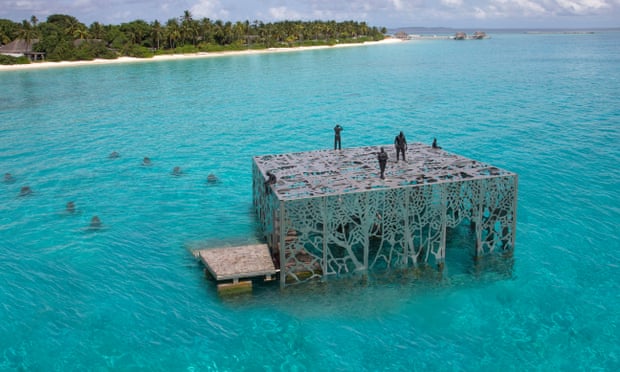
A new sculptural work, Coralarium, created by artist and environmentalist Jason deCaires Taylor, was demolished last week after it was deemed anti-Islamic. The semi-submerged artwork was criticised by religious leaders and scholars in the Maldives, where Islam is the official religion. The depiction of human figures in art is discouraged under Islamic law.

The government ordered the destruction of the artwork, after a court ruled it to be a threat to "Islamic unity and the peace and interests of the Maldivian state", the Maldives Independent reported, despite the authorities previously granting permission.

The project by DeCaires Taylor, who is known for his underwater sculptures and galleries around the world, was commissioned by the Fairmont Maldives Sirru Fen Fushi resort, owned by the Accor hotel group, as an "intertidal gallery", and was completed in July. The large steel frame with cutouts aiming to mimic the marine world was intended to allow sea life to explore freely within, acting as a new habitat for coral and other species. Thirty human figures were positioned on top and inside the frame at tidal level, with others submerged beneath. The sculptures were based on life-casts of people, around half of them Maldivian, with some reimagined as hybrid forms including coral or root-like elements.

Nine months in the making, its creation involved a large team of marine engineers, steel fabricators, divers and mould-makers. Specialist materials included pH-neutral steel, which is safe for use in a marine environment. Changing according to light and tides, the artwork was open to resort guests and day visitors.

However, on 21 September the work was destroyed under court order with pickaxes, saws and ropes.

Thursday, August 30, 2018

Can we stop fighting nature and start working with it?

Thirteen years ago, America changed. Hurricanes Katrina and Rita swept across the Gulf of Mexico and Louisiana with catastrophic force, upending lives and devastating entire communities. For the people of Louisiana and the Gulf Coast, nothing would be the same again. From that moment on, the lives of those who survived this terrible tragedy would forever be divided into two timelines - pre-Katrina and post-Katrina.

Since then, communities across the nation have seen a record number of hurricanes, wildfires and floods. And we know that the changing climate will only continue to exacerbate these threats. The saying that "today's flood is tomorrow's high tide" has perhaps never been more pertinent than when it comes to protecting our coasts.

If we want to prevent future tragedies of the magnitude of Hurricanes Katrina, Rita, Harvey and Maria, we need to shift our thinking from reacting to disaster to proactively managing these increasing risks by working with nature to design resilient systems and green infrastructure.

As a foundation with deep investments in tackling critical environmental problems by working with community partners to advance solutions that also make economic sense -- we believe that building a robust restoration economy is the clear answer. Why?


At the heart of plans to restore Louisiana's coast are projects that restore the natural function of the Mississippi River to deposit sediment that will rebuild and sustain wetlands. These sediment diversions, as they are called, are the best chance we have to slow the loss of coastal wetlands that so many people depend on for their communities, their livelihoods and their way of life.

Sediment diversions are an important piece of a larger 50-year, $92-billion Coastal Master Plan the state has developed to prioritize projects across the coast to build or maintain the most land. The aims are to build 800 square miles of wetlands, rebuild barrier islands and oyster reefs, and restore marshes to protect communities and habitat. To pay for this plan, the state is using oil spill funds as a down payment. It is also looking at new financial approaches such as environmental impact bonds and outcome-based, 'pay for success' contracting, as well as public-private partnership structures.